 By admin
When Karla Padilla started her sentence at the federal correctional institution in Dublin, Calif., in 2023, a guard singled her out. Over the next 15 months, the guard strip-searched Padilla so frequently that anyone near her risked being searched too, and other inmates began keeping their distance whenever that guard was on shift.
Read more Why Tenant Unions Are Spreading Across College Campuses
Most prisons across the country conduct strip searches under a federal policy that requires women officers to inspect incarcerated women. The officer instructs them to remove their clothes, shake their hair, open their mouths, lift their breasts or genital area and then bend, squat and cough.
On one particularly cold day in November 2023, while Padilla was cleaning the chapel, the guard demanded that Padilla strip for a search in full view of four male guards stationed there.
“I told her I was on my period,” Padilla recalls. “And she said, ‘Shut the fuck up and strip down. Do what I say or you’re going to go to the SHU.’” The SHU — the Security Housing Unit — is more commonly known as solitary confinement.
Padilla removed her clothes and menstrual pad, standing naked in front of male guards for five minutes, as the guard made her turn, squat and cough, then repeat three more times.
“She had a smirk on her face,” Padilla says. “She knew what was going on. She knew all these people were watching. She knew it was very humiliating.”
Throughout her 15 months at the facility, Padilla says she came to realize that such humiliations were unavoidable. Before the chapel incident, when she refused a guard’s demand to strip, she was thrown into solitary confinement and underwent several more strip searches before being returned to her cell.
Padilla left Dublin on Feb. 20, 2024.
Again and again, advocates pushing to restrict or abolish strip searches run into the same institutional logic: Where there are prisons, there will always be strip searches. Organizers and activists have achieved some wins, but since strip searches are considered security-essential, more substantive reforms keep hitting a wall.
But strip searches, framed as a security measure, have also been used as a tool of abuse.
Aimee Chavira was transferred to Dublin in 2019 after spending time in an immigration detention center.
She remembers when the searches weren’t even dressed up as security protocol — they were just brazen acts of abuse. She recalls an incident in which a male guard made sexual advances toward her, which she refused. In response, he would call a woman guard to do a strip search. “This is not normal behavior,” Chavira says. “It’s kind of hard to do a sentence. You’re thinking to yourself, I’m sentenced to 10 years in prison. How am I going to maintain my sanity for these 10 years with this kind of abuse, sexual assault?”
The searches left her with a lasting aversion to physical touch. “There’s no fix,” Chavira says. “These are traumas that I’m going to continue to have throughout the rest of my life. When I go to an airport, I can’t have people touch my arm, I feel uncomfortable, you can’t hug me, I can’t feel your hands on me. In my mind, I am thinking you are doing it in a sexual way. So that doesn’t go away. This is a trauma that they are creating and that they’re gonna leave a stamp on you forever.”
Prisoners and workers have called the prison “the rape club,” the Associated Press reported in 2022. After years of complaints alleging rampant sexual abuse and human rights violations, eight women in August 2023 filed a class action lawsuit against the prison and its staff. It ceased operations in April 2024. In These Times reached out to the U.S. Attorney’s Office for the District of Montana, which represented Federal Correctional Institution (FCI) Dublin in the litigation due to a conflict of interest among Northern California federal prosecutors, for comment. A spokesperson responded, “Our office cannot comment on matters in active litigation.”
“This is where people tried to commit suicide over the acts that the officers were doing,” Chavira says. “You have sexual assault, rape, abuse, so much abuse of the women who were there. We just got it shut down.”
Susan Beaty, senior attorney at the California Collaborative for Immigrant Justice, was one of the attorneys who represented the women. Beaty heard many stories about abuse, sexual harassment, sexual assault and strip searches.
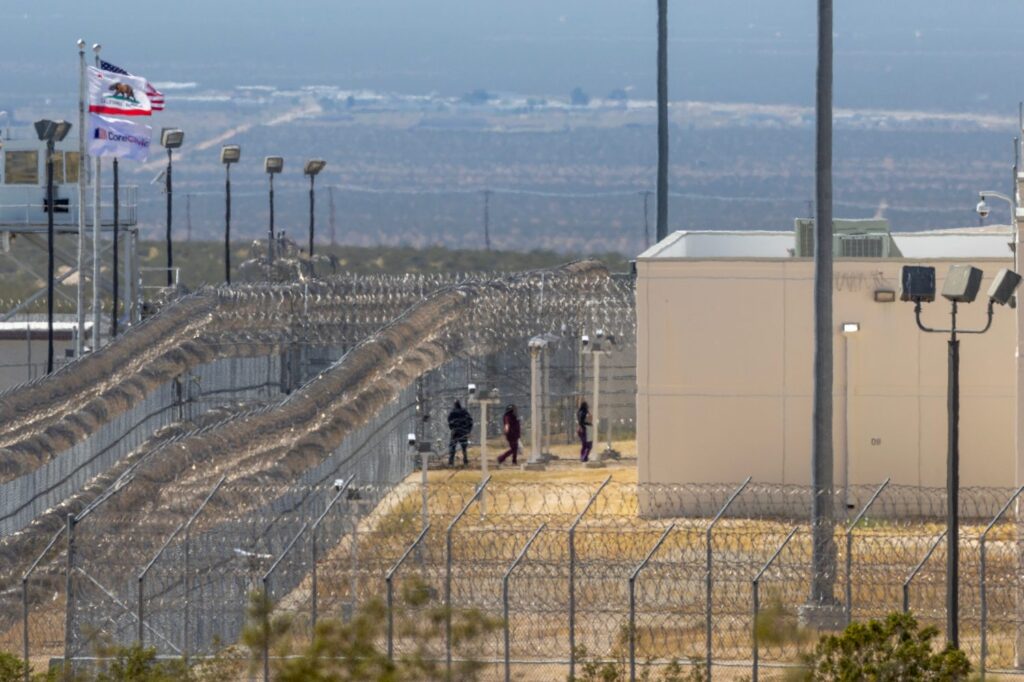
“I’ve been going there for many years,” Beaty says. “And never once had the facility strip-searched someone before or after they spoke with me. After we brought the lawsuit and were in front of the judge, they very suddenly started strip-searching every person who met with attorneys before and after their visits. Which felt like both an attempt to intimidate people from speaking out, from accessing lawyers and advocates and a punishment for anyone who did speak out.”
The case reached a settlement in 2025, when a federal judge approved a consent decree that applies to more than a dozen federal women’s prisons across the country. It instituted enforceable protections, such as more extensive monitoring of potential abuses and reporting systems, and expunged some disciplinary write-ups by Dublin staff.
As part of the final decision, the Federal Bureau of Prisons (BOP) director issued a public acknowledgement to women who experienced sexual abuse at FCI Dublin.
“For the first time in BOP history, a consent decree will provide ongoing court oversight across multiple federal women’s prisons,” said Beaty in a press release. “This agreement acknowledges that the abuses at FCI Dublin were not isolated incidents but part of a nationwide pattern of harm.”
Approximately a year after the closure, Immigration and Customs Enforcement (ICE) began touring the facility. Many advocates, attorneys and formerly incarcerated women, like Padilla and Chavira, fear the Trump administration is planning to reopen Dublin and turn it into an ICE detention center.
“We know what’s going to happen if they reopen it,” Padilla says.
Alyssa Benedict is the executive director at CORE Associates and co-founder of Women’s Justice Institute, an organization dedicated to trauma-informed justice in women’s prisons. Benedict has spent 25 years training prison officials on trauma-informed approaches, starting with juvenile facilities before shifting her focus to adult women’s prisons.
“If we are only brought in to train,” Benedict says, “we find that there is a real lack of knowledge of research on women.”
What does exist paints a troubling picture. At least half of women in prison have experienced gender-based violence. Research shows that strip searches can trigger reminders of past sexual abuse. “The body is so shocked with what’s happening,” Benedict says, “that women are experiencing a number of physical reactions — deep-seated fear, heaviness in the chest, elevated heart rate and sweats. It’s everything that she might have experienced when she was sexually assaulted.”
Some scholars, like Jessica Hutchison, a social work professor at Canada’s Wilfrid Laurier University who has studied the harmful effects of strip searches on incarcerated women, have described strip searches as state-sponsored sexual assault.
“If we replace the words ‘strip searching’ with the words ‘sexual violence,’ the nuance and actuality of what happens comes to light,” Hutchison says. “Imagine if we say, ‘Katie went out to the community, and when she went back to the prison, she had to be strip-searched.’ That evokes one image in our mind. But if we say, ‘Katie went out to the community and when she got back to the prison, she had to be sexually assaulted,’ that’s a different visual.”
Emily Galvin Almanza, executive director at Partners for Justice and author of The Price of Mercy: Unfair Trials, a Violent System, and a Public Defender’s Search for Justice in America, notes the discrepancy between how women are often treated while incarcerated and how the legal system treats far less severe instances of sexual misconduct or public nudity.
“On the one hand, our government says peeing on a bush is sexually dangerous, slapping a butt is sexually dangerous,” she says. “And on the other hand, it says that shackling a woman, forcing her to remove all of her clothes, to remove her tampon, to show a guard her menstrual pad and have a stranger [inspect] her vagina and buttocks is not sexually abusive. It’s not a sustainable intellectual take.”
According to Benedict, policy changes around strip searches consistently run into institutional resistance. “It’s much easier to make the case,” Benedict says, “let’s train your workforce in how to communicate in a trauma-informed way. Changing strip searches, I think, inspires a lot of concern on the part of facility leaders around contraband and what may come in.”
Since the beginning of her career, Benedict has seen more attention paid to the experiences of incarcerated women — after decades, she says, of being invisible and ignored. She and her team are now working with prisons and jails to rethink strip-search policies. But progress has been slow. “I’m more likely to hear from states that they’ve tried to make adjustments, but I still think there’s not enough places doing it and not enough places doing it completely. There’s more work to be done,” Benedict says.
Jennifer Toon spent 20 years in a Texas prison. Strip searches were one of the things she hated most about her time there. “It was the experience, I would say, that united all of us in our hatred,” Toon says. “I can’t even count how many times I have had to take my clothes off over and over and over.”
Toon remembers strip searches that were conducted in view of guards who would comment about their bodies or odor or scream at them to take their clothes off. Toon says she worked to schedule her visitation time around her menstrual cycle so she could avoid being strip-searched while on her period.
In These Times interviewed 11 currently or formerly incarcerated women who each described how traumatizing it is to be strip-searched while menstruating. Many recalled being ordered to remove their pads or tampons. One woman reported that when she bled onto the floor during a search, she was told to clean it up.
“Being forced to remove your menstrual devices— it’s not just humiliating and traumatizing, but physically painful,” says Galvin Almanza. “Removing a dry, recently inserted tampon can be painful and even dangerous if pieces of it break apart in the process.”
The experience is so traumatizing that some incarcerated people have tried to suppress their periods altogether. “One woman in my study said that she started taking [birth control] … because it stopped her period,” Hutchison says.
But menstrual products can be difficult to access in U.S. prisons. Women forced to remove pads or tampons for a strip search may struggle to find a replacement.
Toon left the Texas prison on Dec. 13, 2018. When she was released, she began writing about her experience there. A year and a half later, she got a fellowship at the Coalition of Texans with Disabilities, which jump-started her activism and policy work. When Melissa Lucio — a woman Toon and many of her friends knew personally, some from the same unit— faced execution in 2022, Toon and a group of formerly incarcerated women formed Lioness Justice Impacted Women’s Alliance to advocate for incarcerated women in Texas. Lucio’s execution was stayed in 2022, and a district court judge later declared her innocent — but as of 2026, she remains on death row, awaiting a final ruling from the Texas Court of Criminal Appeals.
Lioness now organizes around solitary confinement, the lack of air conditioning in Texas prisons and strip searches.
When the organization learned that a bill addressing strip searches during medical transports was moving through the Texas Legislature, Toon and a group of formerly incarcerated women approached Sen. Royce West (D-Texas) in 2023 to discuss the policy. “I was told to ‘lean back and skin it back till it was pink,’ Toon’s friend testified during a legislative hearing in March 2023. “That meant fully opening my vagina. That is the type of strip searches that we endure on medical transport.”
In February 2023, during the 88th Texas legislative session, West filed Senate Bill 1146 to reform stripsearch practices specifically during medical transports. The bill prohibits ankle, leg and waist restraints and invasive body cavity searches during those transports, and allows incarcerated women to bring toilet paper and feminine hygiene products.
The medical transport bill moved quickly through the legislature; it received minimal opposition and was signed into law on June 18, 2023.
“A piece of legislation is great, but we don’t have any independent oversight of our prison system,” says Toon. “The only way we know something is happening is from people on the inside, or the state agency reporting on themselves. We don’t have anybody making sure a bill is actually being enforced. This is why we still have trouble with medical transport, because while it passed and it said they need to do certain things, unless advocates stay on top of the bill, who is enforcing it?”
A second bill, introduced in 2025 during the 89th legislative session, sought to overhaul strip-search policy more broadly — and proved far harder to move. At the end of the session, advocates testified at a hearing on the bill. Officials from the Texas Department of Criminal Justice attended and, according to Toon, began making some internal adjustments: They dropped the term “strip search” in favor of “unclothed search,” and ended the practice of group strip searches, which the bill had specifically targeted. But the bill itself did not pass. The core requirement — that incarcerated people remove all their clothing for a search — remains policy in Texas prisons.
The Texas Department of Criminal Justice confirmed the policy changes.
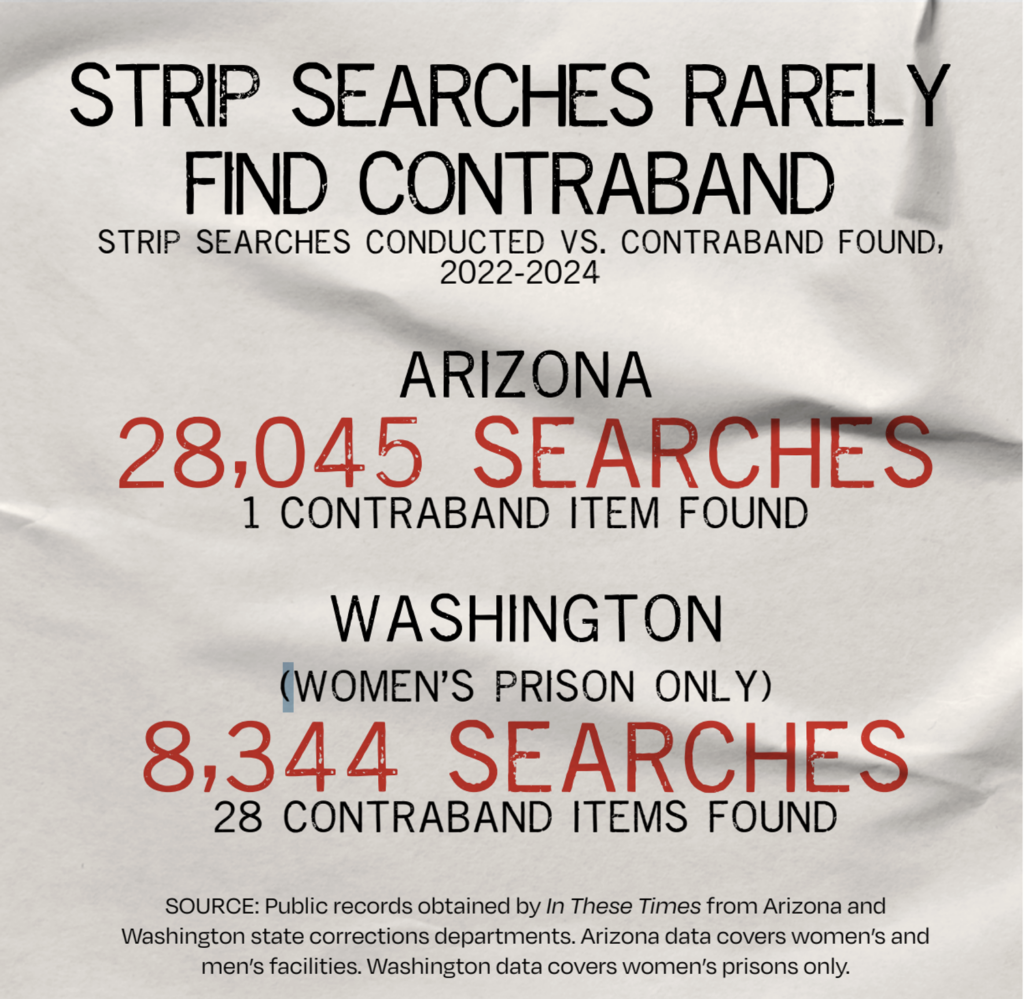
The expressed purpose of strip searches is to combat the flow of contraband into prisons, but data from the few states that track searches suggest the practice rarely achieves that goal. Public records obtained by In These Times from state corrections departments in Arizona and Washington found that strip searches turned up only a handful of contraband items. Of the 8,344 strip searches conducted in women’s prisons in Washington from 2022 to 2024, the state labeled just 28 as having resulted in the discovery of contraband items. In Arizona, which provided data from both men’s and women’s facilities, just one search out of 28,045 did.
The term contraband conjures images of drugs, weapons and alcohol, but, as Galvin Almanza points out, it applies to any prohibited item. “It could be mascara. It could be an extra bowl in their cell. It could be pants that have been hemmed into shorts for the summer.”
In These Times filed public records requests in 48 states, asking for the number of strip searches conducted from 2022 to 2026. Seventeen states responded that they didn’t have or track the requested data on strip searches. Thirteen states didn’t respond. North Carolina, Maine and several other states denied the information requests on the grounds the records are confidential. New Jersey public records officers stated, according to law, they don’t have to reveal the requested information because it jeopardizes security.
“It’s not surprising,” Benedict says about the lack of data. “Women are a very forgotten population. There is a lot that we are missing in terms of the experience that women are having in prison. So, to add some accountability so we can track and reduce unnecessary strip searches is essential.”
Omny Miranda Martone, founder and chief executive officer of the Sexual Violence Prevention Association, says the findings mirror research from other countries. A 2026 Human Rights Law Centre analysis found that fewer than 1% of the more than 15,000 strip searches conducted monthly in Australian prisons turned up contraband. “We are causing mass trauma,” Miranda Martone says, “likely increasing sexual violence in prisons, and it’s not effective; it’s not actually preventing contraband. So the reason for doing it is misguided. This is common in state sexual violence. State sexual violence is justified as a means for safety even though it’s very clearly not.”
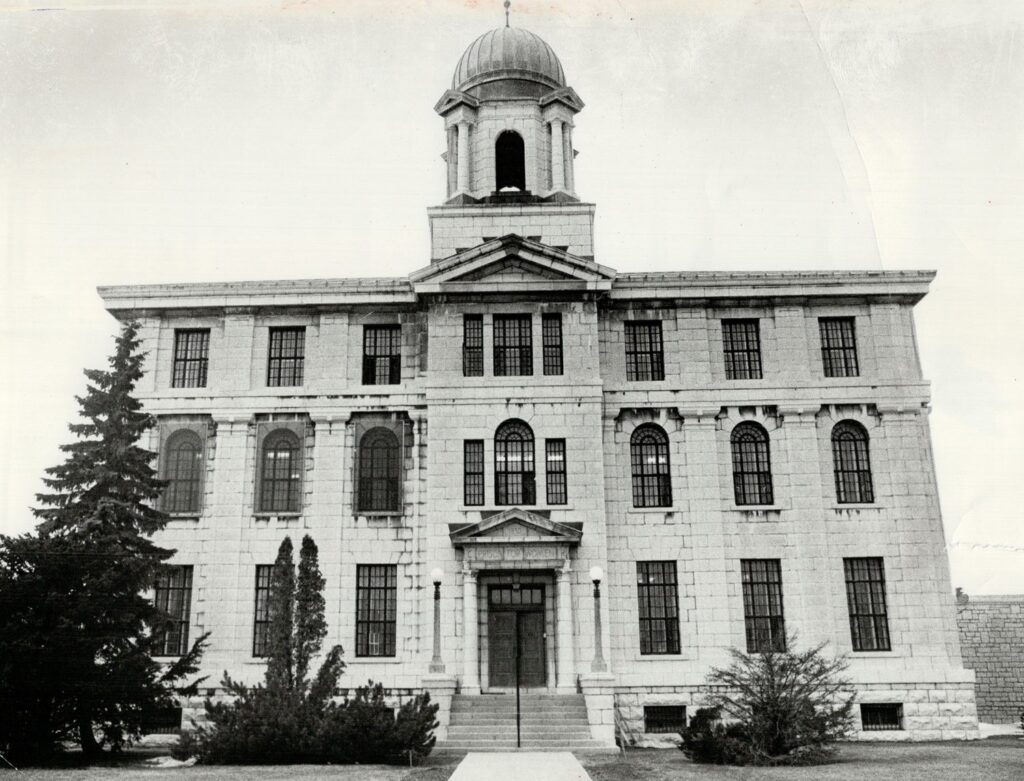
In the mid-1990s, a public reckoning over the treatment of incarcerated women swept Canada. For decades, the Prison for Women in Kingston, Ontario, served as Canada’s only federal prison for women, and it was notorious for its overcrowding — as well as its frequent use of strip searches and solitary confinement.
“Nobody believed that all this stuff happened to us,” says Bobbie Roberta Kidd, who was incarcerated at the facility from 1985 to 1994. “Some of us got beat up badly, got touched; you got hosed down.” The abuse of the conditions, she says, made “women want to kill themselves.”
Between December 1988 and the spring of 1992, seven women at the Prison for Women facility committed suicide. Criminologist Alison Liebling’s 1992 book Suicides in Prison cites research finding that Canadian prison suicide rates in the early 1980s were roughly five times higher than in the general population. Liebling also reported that Correctional Service Canada recorded 160 suicides per 100,000 inmate-years in maximum security institutions, and 90 per 100,000 across maximum and medium security combined.
On April 22, 1994, a group of incarcerated women were involved in a violent confrontation during which two prison guards were stabbed. The women were placed in solitary confinement, where tensions continued to rapidly escalate. On April 26, the prison warden directed an all-male team of guards to conduct a cell extraction and strip search of the women in solitary confinement. The guards, equipped with black armor, helmets and plastic shields, forced the women to lie on the ground, threatened to mace them and cut their clothes off with scissors.
The operation was captured on prison security footage, which was first sent to the Solicitor General of Ontario and led to a commission of inquiry. The video would later gain public attention and outrage after the Canadian Broadcasting Corporation’s investigative show The Fifth Estate aired a documentary called “The Ultimate Response.”
According to the commission’s report describing the video footage — which In These Times was not able to access — a group of eight guards pinned a woman to the floor, cut off her clothes, cuffed her hands behind her back and shackled her legs.
The inquiry concluded with a list of recommendations to make strip searches more humane, including a policy that only women officers be allowed to stripsearch incarcerated women. To this day, the United States has no national policy requiring that only female guards conduct strip searches of incarcerated women. Some jurisdictions have their own such policies, but this varies from state to state.
Still, Hutchison argues the Canadian reform didn’t go far enough.
Despite finding that the strip searches were cruel, inhumane and degrading — and that they violated the Canadian Charter of Rights and Freedoms — Justice Louise Arbour, who led the investigation, stopped short. “Surprisingly,” Hutchison says, “she did not recommend the elimination of strip searches.”
Read more Selling the Sun
The Prison for Women shut down in 2000. A year later, the Supreme Court of Canada ruled in R v. Golden that strip searches in women’s jails should not be routine policy and developed legal standards on determining whether there are “reasonable grounds” for strip searches. New federal women’s prisons were established across the country, intended to be run differently — though as early as 1995, some prisons were already trying a different approach.
In 1995, the Okimaw Ohci Healing Lodge, a federal correctional facility specifically for Indigenous women, was established in Saskatchewan, a province in western Canada. It includes spiritual centers, elder-led teachings and ceremonies and a horse-riding program. The facility retained strip searches as standard practice — even though many of the first women transferred there had been strip-searched at the Prison for Women, some of the very trauma the lodge was meant to address.
“Me and the women would talk about this while playing cards,” says Jessie Black, an Indigenous woman who was sent to the Lodge in 1995 and left in 2001. “We would be like, ‘oh the hell with this let’s start a riot.’ We were sick of it. It builds up and you feel like shit. Even the women at [the Prison for Women] thought that this would be so different than Kingston and it wasn’t.”
Black says women are the birth givers and that Indigenous teachings carry special significance around menstruation — what many Indigenous cultures call “moon time.”
It’s why Hutchison considers strip-searching Indigenous women an “added layer of colonialist violence.”
“When they are being strip-searched on their moon time,” Hutchison says. “That’s another level of spiritual violence that is being enacted against indigenous women. Particularly it’s by the hands of the colonial state, in an institution under the guise of supporting Indigenous women.”
Strip searches “shut you down,” Black says. “It’s just a horrible experience, especially when you are there at a healing lodge. I just didn’t get it, and for the elders to say, ‘oh it’s okay’ — they should have known better. Okimaw Ohci Healing Lodge is like a community. But yet, you still are so barbaric.”
In 2022, the Canadian Civil Liberties Association filed a lawsuit challenging the excessive use of strip searches in both men’s and women’s prisons — a case still working its way through the judicial system.
Kent Elson, a lead attorney on this case, has found multiple instances where strip searches are unnecessary because the person is entering a space where contraband is not accessible.
“There’s four circumstances [where strip searches are unnecessary to use],” Elson says. “One is leaving prison. Another one is prison-to-prison transfers, another one is when you are entering the private family visiting area, and when you are coming in and out of a secure area.”
The 1994 strip-search incident at the Prison for Women did lead to more substantive changes in how women’s prisons function in Canada. But it didn’t lead to the elimination of the strip-search policy that continues to harm women today. All in the name of security.
Edward Aber was the commander of La Plata County Jail in Colorado from 2005 to 2024. Throughout his tenure, he developed a reputation for sexual misconduct. In 2024, 14 female employees reported that, for years, Aber had been making inappropriate sexual remarks and advances. He was placed on administrative leave in July 2024.
“That case led to an investigation,” says Siddhartha H. Rathod, a partner at Rathod Mohamedbhai LLC, which represents the plaintiffs. “They found a number of screenshots on his computer that looked like screen grabs of strip searches.”
Under jail policy, all deputies must wear a bodyworn camera during strip searches; that footage is then automatically uploaded to an evidence.com database accessible only to the sheriff and other select personnel. According to the investigation, led by Lieutenant Joseph LaVenture, from 2019 to 2024, Aber logged into the database at least 3,166 times — viewing 115 strip-search videos from his home and, on at least one occasion, from a hotel.
On September 3, 2025, 18 women who were stripsearched in this jail filed a lawsuit against Aber.
Rathod says his clients have had panic attacks and trouble sleeping since the allegations became public. “They feel like they can’t exist within their own skin because they know that a creepy former jail commander used videos of their strip search to get off,” Rathod says.
The case against Aber has since been consolidated into a class action lawsuit, Hiehle v. Aber. La Plata County has filed a motion to dismiss its liability. Aber also faces more than 100 criminal charges related to the allegations; his lawyers have requested that the criminal trial, scheduled for November, be moved out of La Plata County, arguing that widespread local coverage of the case makes a fair jury pool impossible to find there.
Between January and March 2025, the Women’s Huron Valley Correctional Facility in Michigan — the only women’s prison in the state — required guards to wear body cameras during strip searches. Prison officials claimed that, since cameras are always recording, they feared reprimand for not conducting searches precisely by the book.
During those three months, hundreds of women were allegedly either forced to undergo a strip search while being recorded, or were recorded while taking a shower or using the bathroom. According to the lawsuit, officers at men’s facilities routinely chose not to wear cameras during strip searches, while officers at the women’s facility strictly enforced the policy — creating what plaintiffs describe as “blatant sex discrimination.”
After mounting pressure, MDOC amended the policy in March 2025, requiring that cameras be placed in sleep mode during strip searches. But according to a $500 million lawsuit filed against MDOC in May 2025 by 20 women — each identified as Jane Doe— some officers continued recording women in states of undress even after the change. Though the lawsuit was dismissed in October, the women’s attorneys have appealed the ruling.
The Michigan Department of Corrections (MDOC) did not respond to requests for comment sent to its transparency liaison.
The Michigan lawsuit was part of a broader wave of legal and legislative scrutiny. In August 2025, Connecticut approved funding for a pilot program to introduce body scanners at two prison facilities, with the stated aim of eventually ending strip searches statewide. In Idaho, a bill was passed in 2026 to make it a felony for prison staff to engage in sexual contact with incarcerated people.
On May 28, Governor Jared Polis of Colorado signed HB26–1123, a law limiting strip searches in state jails and addressing some of the conditions that enabled Aber’s abuse. The law requires that two personnel agree there is reasonable cause before a search is conducted and that the reason be documented. It restricts access to strip-search footage to legitimate law enforcement purposes and requires officers to document why they are seeking access. It also prohibits the use of body-worn cameras during strip searches and requires facilities to submit annual reports on the total number of searches conducted, their reasons, and their results to the Colorado Legislature and the attorney general.
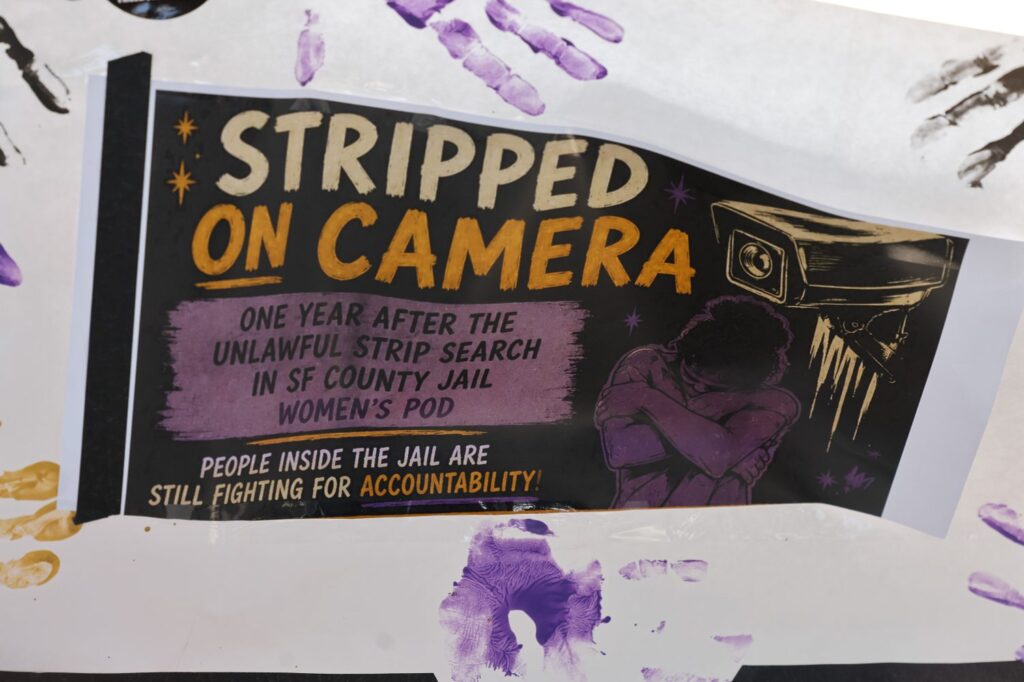
That law emerged from a lawsuit that is still ongoing. In California, a similar lawsuit unfolded in San Francisco. On May 22, 2025, at least 10 deputies at the San Francisco County Jail, mostly men, rushed to the unit, removed a group of women from their cells and told them to strip. They were then subjected to a visual body-cavity search while male deputies watched, laughed and made comments. In late May, 20 women who had been held in the jail filed a federal civil rights class-action lawsuit against the city and county of San Francisco, alleging they had been illegally stripsearched while incarcerated.
Since the Trump administration took office in January 2025, deportations have surged and shuttered prisons — some closed due to inhumane conditions — have been reopened as immigration detention centers. FCI Dublin may be next. When ICE conducted a tour of the facility in February 2025, advocates formed a coalition to fight its reopening.
The ICE Out of Dublin Coalition unites immigrant rights groups, legal organizations, labor unions and faith communities around the same goal: stopping the Trump administration from turning FCI Dublin into an ICE detention center. For women like Padilla and Chavira, who experienced abuse there firsthand, the stakes are personal. The coalition’s first step was community outreach — many residents, they found, were unaware the facility was being considered for use by ICE.
“In the spring, the coalition did neighborhood canvassing in Dublin. There was very regular outreach at the farmer’s market,” says Marla Kamiya, an organizer with Tsuru for Solidarity, an organization founded by survivors and descendants of Japanese Americans incarcerated during World War II that works to end the expansion of detention centers. From there, the coalition began holding rallies to protest the detention center.
However, they realized they needed more than local pressure alone. They set their sights on getting national attention. First, though, they needed to make headway in state government.
“What we landed on is we needed to ensure that our local elected officials were not complicit,” Kamiya says. “We started with the Dublin City Council, and we felt this was a really crucial way to engage and involve the local residents of Dublin.”
They mobilized community members to attend two Dublin City Council meetings in November and December 2025. Then they met individually with the city manager, the mayor and five council members.
“When we felt there was some sympathy for this,” Kamiya says, “we decided we would mobilize people for the public comment period of our November city council meeting. There were well over 40 Dublin residents who spoke about why they don’t want a detention center in their city.”
In December 2025, the Dublin City Council passed a resolution opposing the facility’s conversion to an ICE detention center.
“After we got the City of Dublin resolution — which we felt was really the most important thing — we said, let’s try to do a similar effort with the Alameda County Board of Supervisors,” Kamiya says.
In January, Supervisor Nikki Fortunato Bas of the Alameda County Board of Supervisors introduced two resolutions the coalition had been pushing for: one establishing rapid-response protocols for Alameda County agencies in the event of federal immigration enforcement, and another declaring the county an ICE-free zone.
“Then we decided we did need a resolution specific to Alameda County Board of Supervisors going on record that they don’t want a detention center in Dublin,” Kamiya says.
On April 7, in a dimly lit room, the Alameda County Board of Supervisors held a public meeting to vote on a resolution opposing the reopening of FCI Dublin as an ICE detention center.
“We are here today to let the federal administration know that we do not want to see any more prisons and specifically detention centers in our community,” says Supervisor Elisa Márquez.
Alameda residents filled the room. People held signs reading “NO ICE PRISONS.” Nearly 100 residents spoke out in favor of the resolution. Many expressed fears about how reopening Dublin could lead to increased ICE presence in the community. Some residents have reported seeing ICE in the area. A Palestinian organizer spoke about how Palestinian groups deemed by the government as domestic terrorists in the Bay Area could be sent to the facility.
The resolution passed unanimously.
“We were very happy that it passed,” Kamiya says. “Alameda County Board of Supervisors is a really important and powerful leadership body in the region. Having them on record certainly helped.”
Despite all these efforts, the decision ultimately rests with the Trump administration — FCI Dublin is on federal property and is not subject to local zoning laws.
“The Trump administration is aggressively looking to expand detention,” says Beaty. “Specifically in Northern California where there are no detention centers.”
Congressman Mark DeSaulnier (D-Calif.) represents the Northern California district where the Dublin prison remains. In an email to In These Times, a spokesperson from the Department of Homeland Security (DHS) stated that ICE has no plans to use FCI Dublin for immigration detention — a claim DeSaulnier remains skeptical of. “Given the congressman’s skepticism of this administration and ICE’s ongoing partnership with [BOP] for immigration detention,” says Mairead Glowacki, communications director for DeSaulnier’s office, “he is doing his due diligence in continuing to press them on this issue to conduct oversight and ensure this doesn’t happen.”
The same email, however, noted that ICE has new funding to expand detention spaces.
“DHS and [BOP] have proven themselves to be extremely untrustworthy agencies that have a long record of lying to the public,” Beaty says. “I think the response from community advocates and organizers has been to be always vigilant.”
In May 2026, BOP published its environmental assessment report on FCI Dublin, which confirmed several hazards, such as black mold and a failing sewer system. Members of the ICE Out of Dublin Coalition criticized the report, calling it too narrow. The coalition also fears that publishing the environmental assessment clears the bureaucratic hurdles for Dublin to be transferred to the General Services Administration (GSA). NPR reported in late 2025 that the GSA has formed a surge team to help secure space for ICE. The coalition has begun organizing against the transfer of Dublin to the GSA.
In response to In These Times’ request for comment, BOP stated that “despite BOP’s unprecedented steps and providing a tremendous amount of resources to address culture, recruitment, and retention, aging infrastructure, and, most critically, employee misconduct at FCI Dublin, it was determined that the facility was not meeting expected standards and that the best course of action was to officially close the facility. There are no plans for the facility at this time.” BOP also noted that a $117 million settlement was paid to 103 current or former inmates and that it “strongly condemns any sexually abusive behavior.” Immigration concerns, BOP added, should be directed to DHS.
Beaty says immigrant women have always been the most vulnerable people in the prison system because there is no accountability for the guards.
“I think strip searches are just one way that prison staff coerce and abuse incarcerated people,” Beaty says. “It’s normalized and a routine in the prison context but invasive, humiliating and unthinkable for people outside of a prison context to be allowed to do this.”
When asked about solutions, many activists, lawyers and formerly and currently incarcerated women largely agree: Strip searches need to be eliminated entirely. But most agree that in practice, some substitute would be needed. Body scanners are the most commonly proposed option.
Recently, the Sexual Violence Prevention Association has organized a new campaign to stop strip searches. The aim is to challenge the laws surrounding strip searches and eventually end strip searches altogether within five to 10 years using a multi-pronged approach: helping the public recognize strip searches as sexual violence, supporting state legislation limiting or abolishing the practice and opposing bills that would expand it. The campaign’s longer-term aim is to bring the issue to the federal level and change strip-search law nationwide.
Miranda Martone, who is leading the campaign, knows the wall of institutional resistance she and others keep running into. Her response is that even if contraband is found from a strip search, it’s still a violent act.
“If you are causing a bunch of harm in the name of safety, are you really creating safety or are you just causing a whole bunch of harm?” Miranda Martone says. “We often explain to people that if your goal is community safety, these strip and cavity searches are not achieving it. Strip searching is sexual violence. It’s the government committing sexual violence against people.”
Jane Houseal contributed research and public records reporting to this investigation. Natalie Jonas contributed legal reporting.
Read more The Big Idea: Winning