 By admin
New jail construction is quietly booming across the United States. Some may be surprised to learn that during the most intense jail-building years, from 1990 to 2005, a new facility opened every 10 days.
Read more “We Demand Freedom”: Immigrants on Strike in New Jersey Prison
There are nearly 2 million people presently caged in more than 6,000 correctional facilities across the country, including 1,566 state prisons and 3,116 local jails. Recent data shows that number has only grown, and the push to build new jails and prisons continues.
Currently, a new $3 billion jail in Brooklyn is moving ahead, a $1.25 billion prison in Alabama is nearly complete and, among many others, lawmakers in Hawai’i are considering a new $1 billion mega-jail, a facility with more than 1,000 beds.
According to the Prison Policy Initiative, while the stated goals of jail construction are safety, security, and solving jail overcrowding, the result is most often hundreds or thousands of new jail beds to incarcerate even more people and a windfall for contractors in charge of designing and building new jails.
Because jail construction feels so mundane, it’s more remarkable when proposed jails don’t get built. That’s why many organizers are focusing on new jails and carceral institutions, because, as hard as it is to defeat new construction, it’s even more difficult to close a facility that’s already open.
In California, the ICE Out of Dublin Coalition is leading the opposition to a proposed detention center. In Massachusetts, the abolitionist nonprofit Families for Justice as Healing made its mark in 2020 by significantly slowing the process for a new women’s prison. Elsewhere in the Northeast, the group Free Her Vermont successfully pushed back against a $90 million proposal for a new women’s facility.
Since 2021, Atlanta has been known as a focal point for abolitionists, as organizers there mounted a massive campaign against a $120 million police training facility, dubbed Cop City, in the wake of the Atlanta police murder of Rayshard Brooks. But Cop City hasn’t been their only terrain of struggle.
In July 2024, the Fulton County Board of Commissioners rejected a proposed $2 billion mega-jail — a big win for the organizers who fought to prevent the project and instead pushed for investment in prearrest diversion, mental healthcare and other community resources.
“If that money can be redirected to provide services and resources in the community, then we wouldn’t need a $2 billion jail or new jail, period,” explains Robyn Hasan-Simpson, executive director of the nonprofit Women on the Rise.
It’s about “getting people to understand,” Hasan-Simpson said, “what would really bring” about change, in contrast to just locking people up.
But now, a different jail proposal is moving forward, setting up a new round in the struggle.
The Fulton County Jail, often referred to as “Rice Street,” has been plagued by overcrowding since it opened in 1989. Originally built for 1,125 people, it now frequently holds more than 3,000 people, serving as the main site of pretrial detention for the city of Atlanta.
Conditions are, by all accounts, horrific. Hundreds of men routinely sleep in plastic “boats” on the floor of common spaces. Fifteen people died in the jail in 2022 alone, all of them Black, including Lashawn Thompson, whose family described his death as being “eaten alive by insects and bedbugs.” A November 2022 investigation by the Southern Center for Human Rights revealed that, in one unit for people with mental illnesses, every individual had lice, scabies or both. Ninety percent of those in the unit had lost muscle mass and fat from malnourishment.
Lawsuits involving the Fulton County jail have been relentless. The county has hemorrhaged funds, from $4 million paid out to Lashawn Thompson’s family to $2 million paid out to hundreds of people whose release dates were ignored in 2014 because of a database outage.
“I had knives put to my throat, and I had to call my mom telling them, ‘Please wire somebody some money or I’m going to be killed,’ ” one former detainee told the Fulton County Board of Commissioner in September 2023. “Nobody should be subject to that at a jail where you’re supposed to be waiting to get your day in court.”
As County Commissioner Khadijah Abdur-Rahman tells In These Times, people who get arrested in Fulton County sometimes “feel like it’s a death sentence.”
Because of its size and conditions, the jail has been under federal supervision multiple times, first for about a decade starting in 2006, then again following a 2024 Department of Justice investigation exposing the jail’s violence.
Regardless, not much changed, and the Fulton County Commission insists the jail’s problems stem from operational issues in the sheriff’s office.
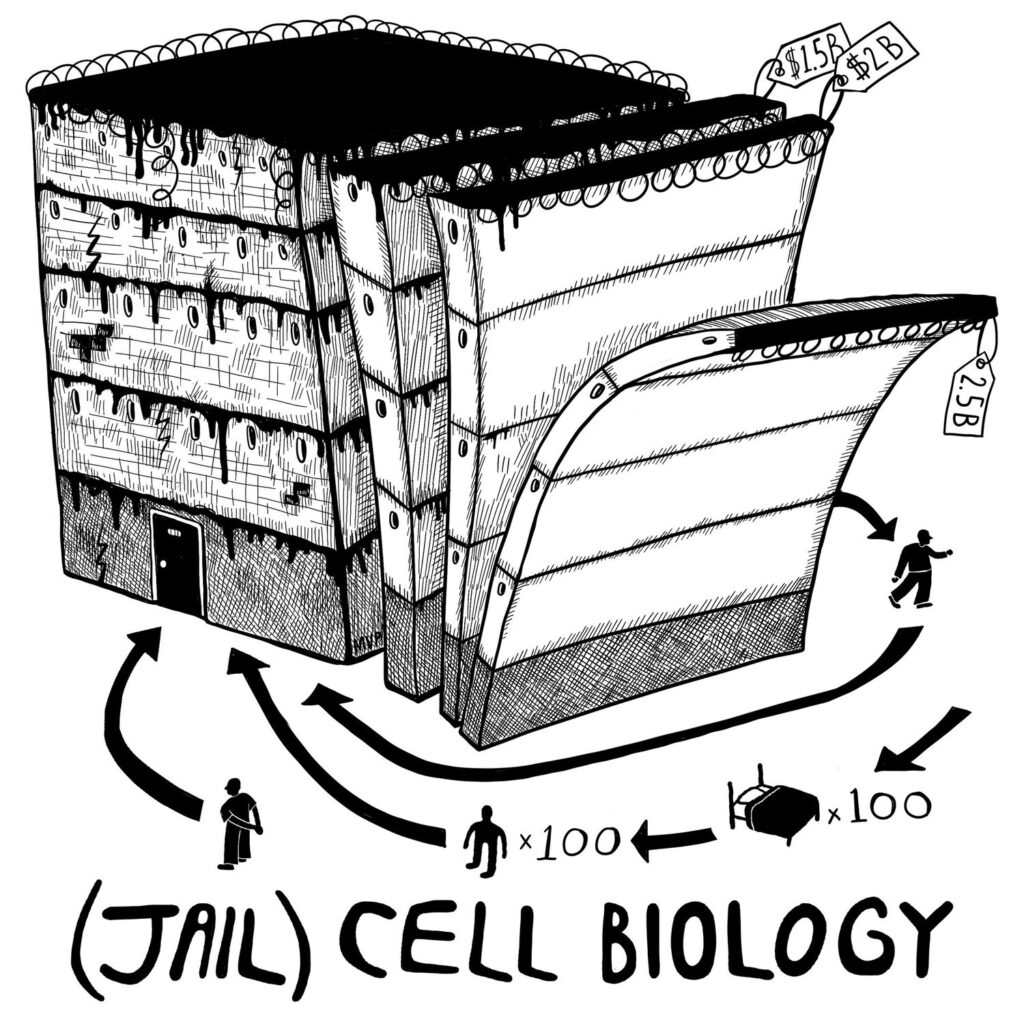
One solution to the overcrowding might first appear to be simply building a bigger jail, a line that many in Fulton County’s political leadership have parroted, going back decades. County Commissioner Dana Barrett took that line in a 2024 guest column for Appen Media, writing that the county needs to invest in “a long-term strategy that is humane, safe and improves public safety countywide.” The defeated mega-jail, which Barrett supported, would have been four times the size of the existing jail and doubled the county’s jail capacity.
Abdur-Rahman takes issue with the idea that a bigger jail would solve the problem, telling In These Times that “the system still will not work in a brand new shiny box.” “The responsibility lies with the sheriff,” she maintains.
Meanwhile, Fulton County Sheriff Patrick Labat — who has also long insisted on the need for a new jail — blames the Fulton County Commission for not allocating enough funds to adequately staff the jail.
“For decades prior to my administration, the sheriff’s office has faced inadequate funding, which continues to cause tension between us properly serving our community and those that want to grandstand during commission meetings,” Labat wrote in statements provided to In These Times. He has also maintained that the district attorney’s office has been irresponsible in moving through its backlog of cases.
Fulton County District Attorney Fani Willis, for her part, claimed in an interview with Capital B News that commissioners are “liars” if they don’t acknowledge how much more expensive the jail is than allocating her office proper funds to process cases more quickly and get more people out of detention faster.
Coalition organizers, in contrast, point out that Fulton County’s repeated attempts to add jail beds by contracting with neighboring municipalities — including a four-year lease for 700 beds in the Atlanta city jail, signed in 2022 — haven’t worked, and that more beds are not the answer. Men are still sleeping on the floor.
Internal disagreements between Fulton officials over solutions to the jail’s problems, and the commission’s July 2024 vote against the new jail, reflect changing opinions on the necessity of new jail construction. According to Hasan-Simpson, the shift
in public opinion against the mega-jail came as organizers began focusing on other options — such as the alternatives-to-policing program that the Community Over Cages coalition has been pushing for years.
“A lot of times — when we are always screaming, ‘Hey, close the jail or don’t build a new jail!’ — they’re looking for, ‘OK, if we don’t, then what?’ ” Hasan-Simpson explains. “And I think once we filled that hole, it filled that gap and gives them solutions, instead of just giving them what they should be doing. “That’s when it opened up their eyes.”
The consulting firm Pulitzer/Bogard & Associates is one of the go-to consultants for jail construction in the United States, regularly winning six-figure contracts for its jail feasibility studies. Currently, it serves as one of the chief architects designing a “mental health diversion center” in Austin, Texas, and the firm wrote a 2024 report in favor of more beds in a jail in Kansas City, Mo.
In January 2022, Fulton County commissioned the firm, among others, for a $1.2 million feasibility study for the proposed mega-jail. The study ultimately highlighted a recommendation for a significantly larger facility (for 5,480 people) at more than twice as much than the $400 to $500 million Labat estimated after he was elected and started to hard pitch commissioners and the public on the project.
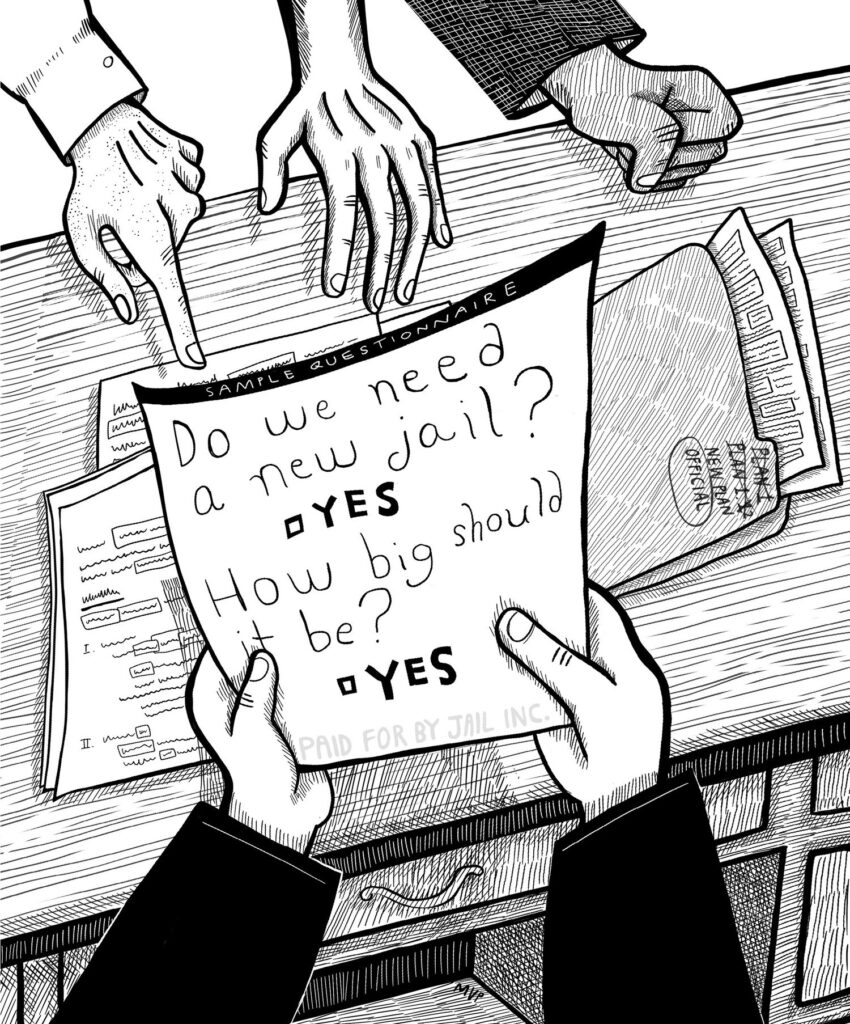
Though framed as an exploration of whether the county needed a new jail, the consultants’ answer was effectively a predetermined “yes,” as evidenced by its leading questions: first, “Do we need a new jail?” And second, “How big should it be?”
Sarah Staudt, policy and advocacy director at the Prison Policy Initiative, notes the Fulton County study is hardly an outlier, and that it’s “extraordinarily rare” for such studies not to recommend new, and more expensive, construction.
When the firm created a similar report for a jail in Hawai’i, the state’s Correctional Reform Working Group noted the population growth projections were “inadequate and misleading.” According to the Prison Policy Initiative, the plan also ignored “straightforward measures that could be used to reduce Hawai’i’s jail population, many of which are cited in the Forecast Report.”
At the request of the Community Over Cages coalition, the Prison Policy Initiative produced its own report on Fulton County, debunking the core claim that a new jail was necessary. When the coalition highlighted the report at a press conference and rally, organizers say it seemed to unsettle the Fulton County Commission.
The Community Over Cages coalition, launched in 2018, has dozens of member organizations representing a wide swath of the Atlanta Left, including the broader Stop Cop City movement. That includes the formerly incarcerated women of color of Women on the Rise, who are fighting to close the Atlanta City Detention Center (the Atlanta city jail) and transform it into a community resource center.
In 2019, after a series of hard-won reforms — marijuana reclassification, bail reform, the end of the Atlanta Department of Corrections’ contract with ICE, and the creation of an alternatives-to-policing program—the coalition won legislation from Mayor Bottoms and the Atlanta City Council to close and transform the city jail. The council’s commitment seemed like a major victory, and the process of designing the transformation began shortly after.
Instead, in 2022, city officials reversed course on their commitment and, in the name of redressing overcrowding at the Fulton County Jail, proposed leasing 700 empty jail beds to the county at a rate of $50 per person per day.
Read more The Poetics of Malcolm X
Organizers who saw the jail transformation plan slipping away fiercely resisted the lease proposal, bringing the coalition squarely before the Fulton County Board of Commissioners. There, coalition members contested the sheriff’s narrative that the problem was inadequate jail capacity.
Though the lease was ultimately approved, coalition members used the fight against it to chip away at the perceived need for new jail beds. Attempting to drive a wedge between the sheriff and Commission members, coalition organizers highlighted the sheriff’s role in the jail’s problems and offered practical solutions to depopulate the jail without adding new beds.
Building on its fight against the lease, the coalition turned its attention to stopping the proposed mega-jail and depopulating the existing Fulton County Jail. In September 2023, coalition member Color of Change, a national racial justice organization, launched a pressure campaign against District Attorney Willis and Fulton County Solicitor-General Keith Gammage, centering their role in the county’s massive case backlog and restrictive bail amounts. In July 2023, Fulton County had more than 39,000 open and unresolved cases, with at least 36% of the jail population languishing in pretrial detention.
The coalition also applied pressure through national and local media outlets that questioned Willis’ status as a hero for the Trump indictment, which Michael Collins, former senior director of government affairs with Color of Change, said prompted a meeting with county officials.
“I saw her [Willis] as somebody who was really more interested in her national profile, but she wasn’t really caring what groups in Atlanta thought of her,” says Collins, “And I knew that we, as a national Black-led organization, could really get under her skin.”
Roughly a week later, Willis pushed internally to reduce the Fulton County Jail population by reducing bail amounts. By the end of 2023, Collins says, the jail population went down by roughly a third — without building any new jail capacity.
In 2024, Collins explains, the coalition doubled down on defeating the proposed county mega-jail. Despite the $2 billion price tag, county officials seemed to be moving forward.
“It was an astronomically high number,” Collins says, adding, “We don’t need this $2 billion deal; the jail population is down.”
The coalition began monthly strategy meetings to chart its campaign against the mega-jail, building on its arguments against the city jail: that the problem was
high bail amounts, case backlogs, frequent arrests for minor offenses and mismanagement, not lack of beds.
“You can safely reduce the jail population by doing things that are just case processing,” Collins says. “There aren’t even bold reforms. I mean, it was just like, ‘Do your job.’ ”
According to Devin Franklin, Movement Policy Counsel at the Southern Center for Human Rights, the coalition’s persistence was one of its most powerful traits.
Members regularly gave comments at city and county meetings to remind officials that, just as the coalition predicted, the city jail lease was failing to solve the problems at Fulton County Jail.
Coalition members also called on officials to increase use of the newly opened prearrest diversion center, another result of the coalition’s advocacy that is meant
to prevent certain arrests in the first place. Robb Pitts, chair of the Fulton County Board of Commissioners, even repeated advocates’ call for diversion, after a report showed Atlanta police were far underutilizing the center.
The coalition also regularly amplified scandals related to the mega-jail’s main champion, Sheriff Patrick Labat. At one point, for example, the private security that Labat hired at the Fulton County Jail walked off the job, citing lack of payment.
On several occasions, Labat’s staff had been arrested for smuggling contraband or abusing those detained.
Labat also successfully pitched the board to contract with a company that coincidentally turned out to be one of his campaign donors.
And the Atlanta city jail lease that Labat had fought so hard for was underutilized — given Labat’s failure to staff the facility.
The coalition’s narrative that, as Collins phrased it publicly, “Sheriff Labat is a thoroughly corrupt individual,” appeared to resonate, with even some of Labat’s previous allies on the commission adding to the chorus of critique.
Originally in support of Labat’s campaign for a new jail, Abdur-Rahman says, “The biggest thing that changed my mind — I’ll be honest with you — is accountability. If you ask the sheriff, ‘Why does this happen?’ he will tell you that it’s everybody else’s fault.”
With each new death in Fulton County Jail custody, Labat and others tried to argue for the mega-jail, but the coalition maintained that “a humanitarian response” was needed instead. The coalition even approached civil rights attorneys working on these wrongful death cases — who sometimes appeared to reflexively call for a new jail — to adjust their messaging. That was another effort that paid off, Collins said.
“Community organizers and people with lived experience actually came together to tell and inform the county about what is really needed and fighting against what the sheriff is trying to propose,” Hasan-Simpson says.
It seemed to work.
Good organizers know that any political win is just one round of the fight, but the next round of the Fulton County Jail fight arrived sooner than most expected.
After voting down the Fulton County mega-jail in July 2024, the Fulton County Board of Commissioners pivoted to a $300 million renovation of the existing jail instead. Many organizers (including the authors of this article) celebrated the development for its drastic reduction in scale and scope compared to the original proposal. And, for a year, it seemed a new jail was off the table.
But in August 2025, Fulton Commission Chair Robb Pitts suddenly announced a new, $1.2 billion hybrid proposal to combine the renovations with the construction of an 1,800-bed “special purpose facility.” The name is meant, Pitts implied, to convey that the proposal is not for a new jail.
The “explicit purpose” of this “special purpose facility,” though, is to incarcerate people with mental health conditions. That’s according to Mark Spencer, part of the group Stop Criminalization of Our Patients, another member of the coalition. Replacing a jail with a “special purpose facility” — replete with cages, restraints and guards — is not offering the care people need, Spencer tells In These Times.
“At the end of the day, [a jail] is essentially the complete opposite of a therapeutic environment. … When [an incarcerated] patient comes to the hospital, they can’t even get medical privacy. Guards sit in their room while they’re shackled to the bed. How is any of this creating an environment that you would think is conducive to mental health and healing?” he asks.
While the Board of Commissioners approved the proposal in August, the so-called special facility is still far from construction — leaving room for continued advocacy by the coalition.
Before voting in favor of the $1.2 billion proposal, Commissioner Abdur-Rahman told In These Times that “I don’t believe that a new jail is needed. We could give the sheriff a billion-dollar jail today, and none of those problems will cease.” And Commissioner Barrett seemed taken by surprise by the press conference organized by Pitts to announce the new facility.
For his part, Labat opposes the current proposal — as too minimal. In a written statement, he tells In These Times that the Fulton County Board of Commissioners is to blame and he has “no doubt the current plan the [commission] recently passed will endure cost overruns north of $2 billion; will take 9 or 10 years to complete; and will have the same impact as the first recommendation I made three years ago.”
The question of who would pay for the $2 billion mega-jail was never fully answered, and the two main financing options — raising county property taxes and passing a new local sales tax — were ultimately rejected as politically untenable. Indeed, in May 2024, state lawmakers signaled they would reject a county request for authorization of a new sales tax, dealing a significant blow to the plan’s proponents.
The new $1.2 billion proposal may suffer the same fate: It doesn’t seem the public is any more interested in increased taxes for jails now than they were two years ago, and skepticism abounds regarding the vague claims that it’s financially possible to build without them.
Whether the proposal will fail on its own or not, the coalition remains committed to fighting it — and to using the fight as an opportunity to change the narrative around incarceration.
Organizers also remain focused on ending the Atlanta city jail lease to Fulton County so the building can finally be repurposed as a community center. They say it’s still about persistence, and staying in the fight — for as many rounds as needed.
“The first couple knocks on the door don’t knock the door down,” says Devin Franklin, an attorney for the Southern Center for Human Rights. “But it makes it easier for the 99th and 100th knock, so to speak, to knock it down.”